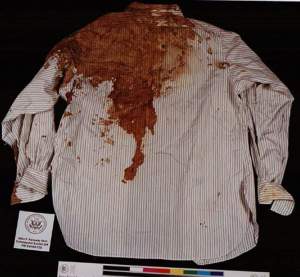
The Somerton Man’s torn and bloodstained shirt overlooked as crucial evidence.
Revisiting the past ……
Professor Cleland wrote a few notes on a copy of a report (see link) he had made to the Coroner and in the first paragraph he mentions he had frequent consultations with DS Leane and visited the site where the body was found with him as well as accompanying Leane to view the case exhibits and the body. Cleland also interviewed and discussed the case with Dr Dwyer, Mr Cowan, Sir Stanton Hicks, Mr Lipaham (lecturer in pharmacy), Dr Poynton and others. In other words Cleland covered the case as thoroughly as you would expect from a man of his distinction and reputation, not to mention that he was previously reported to have assisted in over 700 inquests.
Bloodstains and a tear on the Somerton Man’s clothing.
Sandra P. van Tongeron writes on DA’s FB site : “Concerning the above notes (see link at end of post), it is curious why they did not follow up on the poison theory by checking the body for wounds on the place of said blood stains on the clothing (in the neck of the suit and on the shirt near a tear, as is mentioned in the above notes) or analyse the black powder (if I correctly recall from another document). If one is stabbed/sliced in the neck, one reaches for the afflicted area which may result in defensive cuts/scratches on the back of the hand, as also described.”
Abbott’s response:
“Ok those are Burt Cleland’s personal notes to self I found in an archive over 10 yrs ago.”
And not surprisingly, Professor Abbott made little mention if it. None in fact.
It helps to note that SM was wearing a pullover and coat over the bloodstained shirt, add to that Dwyer didn’t notice any wounds on the body that would account for the bloodstains.
image is not of actual shirt. Cleland’s handwritten notes at end of link.
Some may argue the fact that Cleland’s recollection is recorded on a handwritten note at the end of his official deposition could mean he was the one responsible for not bringing it to the coroner’s attention. We can only ask why.


 The Somerton Man ..
Here we have Clelands hand written notes as per link, ‘Stain with blood on back of neck of? shirt (No stains on coat) … ? from slab etc’….which stand on their own merits without need for the usual enticing enhancements. A fairly common misconception regarding SM’s shirt, be that its collar was a detachable job and there was a spare in the suitcase from memory.
LikeLike
Sounds like a lot of contamination right there, DNA wise.
LikeLike
You really need to take a closer look. There are TWO notes about the blood-coloured stain. You seem to overlook the second note he wrote with more details on the stain in exhibit C, which apparently answers the questions he had about it in the first note in exhibit A (exhibits are marked A-D in the upper right corners).
References to this in the notes included with the report to the coroner:
In exhibit A:
“Stain … blood in back of neck of shirt. (No stain in coat). ? from slab. Who undressed him?”
In exhibit C:
“Shirt – large blood-tinted stain in arch of shirt near tip on one side only of a tear“
Either or both of these notes/observations have been overlooked from day one, and apparently still are. Whilst it was ruled to have been a poisoning, wounds to the skin and the blood-coloured stain on the shirt as a means of poison administration were completely overlooked in the CI. DA apparently overlooked the notes too, amongst other things, believing that Carl W. must have committed suicide.
P.S. You’ve misspelled her name.
LikeLike
Wasn’t it Sandra von whatsit or one of them who thought Carl might’ve nicked himself shaving. Could be on the money but for the ‘Charlie’ part. Some will recall what a bitch it was to remove blood stains from our shirt collars, especially on the road.
LikeLike
The pathologist may indeed have dismissed a nick in the neck as a razor burn, my dear Watson.
However, the blood-coloured stain in the shirt on closer inspection was apparently on one side of a tear only. This particular characteristic of the stain is crucial, and can be used to figure out its cause. IMO the stained tear in combination with the hand abrasions should have been thoroughly investigated and reported at the time, especially as a possible means of poison administration: photograph it, cut it out, have it tested for blood and poison, and swab the wounds on the hand for poison as well.
As for now, for discussion’s sake, it seems unlikely to cause a tear in the back of the neck of the arch of one’s shirt whilst shaving. Moreover, most have their shirts off whilst shaving in the first place. A photograph would have been useful to show the exact location, since it having been in the back of the neck AND near the tip seems contradicting.
As for the identification of Carl W., that’s the coroner’s call. I’d say call him, if you know better.
LikeLike
Bloodstains on his shirt, abrasions between his knuckles? The bloke had been in a fight is my view, and the blood belonged to the other fellow.
LikeLike
At least we agree on one thing Calypso, not everything is as has long been understood .. and for that we can only blame Professor Abbott who cherry picked what he wanted and wilfully ignored what mattered.
LikeLike
Pathologist Dwyer described abrasions between two knucle hollows in the right hand as being insignificant and he found no evidence of likely puncture sites.for injection of curare & c.
LikeLike
Could a poison leave a blood stain on a body? I’m thinking if a particular poison was wiped across the skin, it is absorbed but, in doing so, the skin bleeds. If Cleland realized the true nature of the bloodstain, he decided to keep his finding to himself.
LikeLike