The blood-stained morgue trolley.

Two things.
Professor Cleland noted that he had found on the Somerton Man’s clothing what appeared to be a ‘large blood-tinted stain‘ on the neck of the suit and on the shirt near a tear* (check link’s final handwritten pages.)
But …
the Somerton Man had no wounds on his body other than an abrasion between the knuckles of his right hand, something you might acquire in a fist fight.
~~
SM’s body would have been removed from the ambulance and laid out fully-clothed on what must have been a heavily bloodstained (wooden?) morgue trolley upon its arrival on 1 December before being wheeled inside and stripped.
There were no facilities for testing DNA in the forties just as there were no forensic personnel available to examine the trolley to determine whether any hairs were embedded in the blood stain, remembering the stain was found on the neck of the shirt which suggests a previous occupant had a head injury and some hairs may have been transferred to the Somerton Man’s head by direct contact with the blood patch and were subsequently found to be embedded in the plaster bust constructed by Paul Lawson.
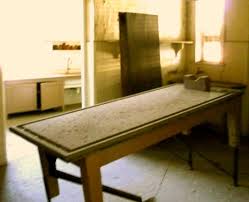
Wooden examination table at the Glenside Mortuary
*Cleland writes like a doctor and is not easily understood.


 The Somerton Man ..
“No stain on coat”, “Who undressed him?” Other remarks from Cleland.
LikeLike
What we know is that he was wearing a suit coat over a pullover and over a white shirt .. for the stain to soak through all of that material suggests the blood patch was still wet .
LikeLike
Seems odd that a dead body would be placed onto a blood stained morgue trolley(?), especially relatively early in a morning. I wonder if another body had been brought to the morgue late the previous night, having been bloodied in an accident, and the blood stains were not cleaned up?
LikeLike
Trove might have something
LikeLike
A bit away from this particular post but, the “News Adelaide” 1 Dec 1948 states that the SM’s legs were crossed and he wore a Brown knitted pullover. If true, what happened to this pullover?
LikeLike
A brown knitted pull-over as well as everything else! This guy was dressed more appropriately for an autumn stroll on Mount Lofty than a December arvo on the beach. No hat, yet no mention of sun burn and, as Dude mentioned a few months back, no mention of mozzie bites.
LikeLike
The American clothes, the tie
What if he actually was Keane.
A Keane from another country.
Flight manifests might not show it.
Or he may have slipped in under the radar
under another name and Keane is his alias.
Keane is not done yet
LikeLike
The stain in the shirt and the tear itself could have been caused by a stab with a blade or razor in the neck penetrating the shirt. On the neck it could have left a papercut, hardly visible or reminding of a shaving cut. The abrasions in between the knuckles could have been defensive wounds, caused when grabbing the neck while being stabbed. The razor might have been poisened. Might have, so no hard evidence.
LikeLike
To be more specific, to me the notes appear to read
In note A:
“stain … blood in back of neck of
shirt (no stain in coat)
? from stab
Who undressed him?”
and in note C:
“Shirt – large blood-tinted stain in back of shirt near tip
on one side … of a tear”
So according to the notes, that means the large stain with tear was only in the shirt and it looked like coming from a stab.
With the expert sir Hicks most suspecting the extremely poisonous arrowpoison ouabain (strophantin), and with cuts in the neck and in between the knuckles, go figure.
LikeLike
I’d like to add that the writing is indeed very hard to read at parts, so it could also be “slab” instead of “stab”. Just as I misread “back of shirt” in my previous post, I actually think it reads
“Shirt – large blood-tinted stain in arch of shirt near tip
on one side only of a tear”.
This is why it’s curious that the discription of the tear and the stain was not typed out and mentioned in the official report. I also wonder whether the notes are from the detective who wrote this report instead of Cleland’s.
LikeLike